

We curated. They came. Now it's ambition to action on carbon and nature in Ireland.

Updated: May 4
On 14th April 2026, something quietly significant happened in the Portal room at Trinity Business School. Over 150 leaders from Ireland's public sector, private sector and practitioner community came together for the inaugural Carbon & Nature Forum — a half-day event built around a single, urgent question: how do we mobilise the finance and ambition needed to drive carbon and nature projects at scale, within and beyond Ireland?
This wasn't a conference. There were no death-by-PowerPoint moments or diplomatic non-answers. It was the Climate Cocktail Club doing what it does best — curating the right people in the right room and asking them to be honest. The Forum was curated by BE IMPACTFUL, under the visionary leadership of Tom Popple — bringing 15 years of trusted advisory experience across the climate and nature impact financing world to bear in designing a programme that was equal parts insightful, truth-telling and provocative. A constructive provocateur by reputation, Tom has mobilised over €500m of new finance for climate, nature and community impact working with some of the world's largest organisations.
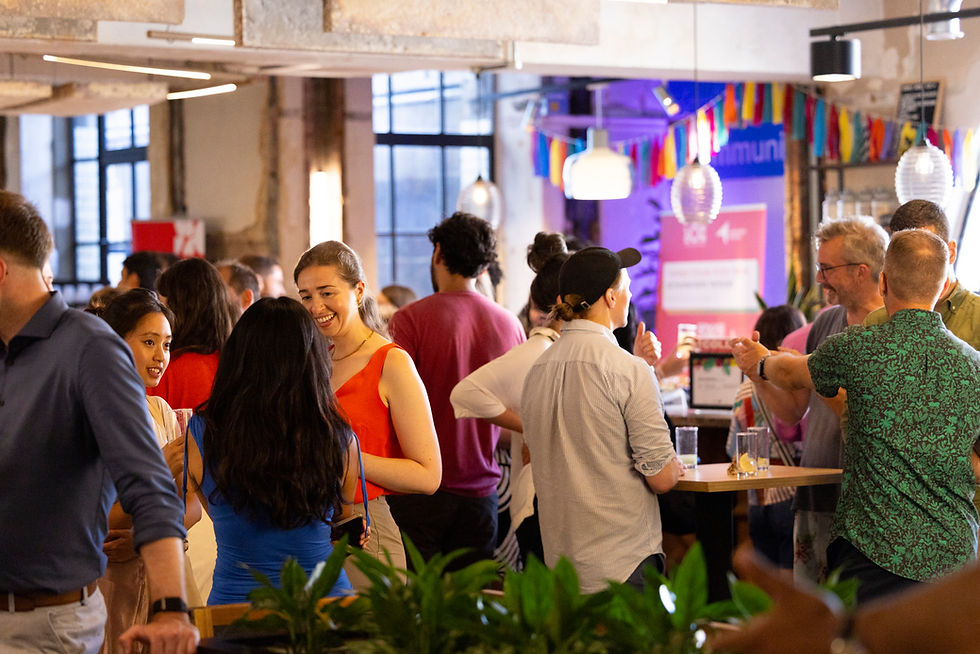
When members of the audience were asked to raise their hands if they were sitting next to someone they didn't know, a roomful of arms went up... that's the power of curating at the nexus.
"Sometimes at these kinds of events it feels a bit like you are preaching to the converted. The Carbon and Nature Forum felt a bit different from that in a really good way. There were people from public and private sector organisations, ecologists, financiers, policy makers, solicitors, etc., etc. There was just the right balance of healthy disagreement, debate, and consensus building. Overall, it was a worthwhile and enjoyable event.” Ciarán Forde, Business Development Manager, Wilderway
None of this happens without the right partners in the right corner. A huge thank you to the Trinity Nature and Business Hub and especially Catherine Farrell for their generous support in hosting and backing the Forum — providing both the extraordinary setting and the institutional belief that this conversation needed to happen. To our partners Lifes2good Foundation, KPMG and Philip Lee — thank you for unlocking the resources that made the Forum possible. Your commitment signals exactly the kind of cross-sector ambition we were asking the room to step into. And to Vita — thank you for offsetting the climate impact of the event. It matters that we walk the talk. Finally, a huge thanks to the delivery heroes who make it happen - Louise French and Orlaith Delargy - magic is real, trust us.
The Carbon & Nature Forum exists because these organisations believed in it before it had a track record. We won't forget that — and we hope the room on 14th April justified the faith. See you in 2027 no doubt!...
“Change happens at the nexus of business, science, policy, activism and culture, not at the expense of one or more of them. This event showcased that when designed right coalitions can be created. Ireland has the opportunity for bold and radical leadership on carbon and nature at scale, it needs to be brave and humble. What a time to play a role in catalysing that ambition” Tom Popple - CEO-Founder, BE IMPACTFUL/Climate Cocktail Club
Vegan bites from B Corp pioneers Tang greeted delegates on arrival — not a throwaway catering choice, but a deliberate statement. If we're asking the room to walk the talk on sustainability, the least we can do is lead by example. Tang, certified B Corp and proof that food businesses can do things differently, did exactly that. And then Jack McHugh started playing. A folk-singing, guitar-slinging songwriter with the rare ability to make a room of 150 professionals forget they were networking.
There's something about live music at an event like this that no icebreaker exercise or name-badge ritual can replicate. It does the work quietly — softening the room, dissolving the professional armour that people arrive in, making it easier to turn to a stranger and start a real conversation rather than a rehearsed one. The networking didn't feel like networking. It felt like people who cared about the same things finding each other. That's the point. That's always been the point with the Climate Cocktail Club.
By the time the programme began, the room was already warm. The hard conversations that followed landed differently because of it.
150 people in the room. That's already a statement. What happened inside was the real story.
Setting the Scene: Ireland at a Crossroads
Political sentiment may fluctuate. Climate and nature timelines do not. Ireland's obligations under EU law and international agreements are fixed — and they will increasingly shape regulation, investment flows and corporate exposure. The question is not whether the transition will occur, but whether it will be managed strategically or imposed abruptly.
The Forum was designed to make the case for the former. Not with grand declarations, but with clarity — about what the market actually looks like, where the gaps are, and what Ireland's unique opportunity might be. Because the thesis at the heart of the day was this: Ireland is not just a recipient of global climate finance trends. It can be a source of capital, expertise and innovation financing projects globally, a destination for high-integrity climate and nature investment, and a hub where state, corporates and institutions co-invest in scalable solutions.
The solutions are not theoretical. They are already being built. What is needed now is greater understanding, increased ambition and coordinated mobilisation.
What the data says: The BE IMPACTFUL 2026 Irish Corporate Carbon & Nature Survey
Before the panels took the stage, Orlaith Delargy, Impact Delivery Lead at BE IMPACTFUL, presented the initial findings of the 2026 Corporate Survey on private sector demand for carbon and nature financing in Ireland. Orlaith brings a decade of experience in natural capital across the private and third sectors — previously Nature & Biodiversity Lead for EMEA at KPMG, Water Programme Manager at CDP and Executive Coordinator at Natural Capital Ireland. She knows where the bodies are buried in this market. Her scene-setting was the kind of reality check that sets a room up for an honest conversation.
The appetite is there — and it is firmly home-grown. When asked how likely their organisation was to fund carbon and nature projects if credible options were available, 79% said they were somewhat or very likely to fund carbon projects in Ireland, and an even stronger 86% said the same for nature projects in Ireland. Contrast that with international projects — where only 41% expressed likelihood for carbon and 35% for nature — and the signal is clear: Irish organisations want to invest in Ireland. The demand is latent. The projects need to meet it.
Irish corporates are already reporting on impact — 69% report on carbon and GHGs, with waste management (66%), biodiversity (48%) and local economy benefit (48%) also featuring strongly. The building blocks of accountability are in place. What's missing is the next step: translating reporting into financing.
On barriers, the top three were cost and budget constraints, uncertainty about regulation and reporting requirements, and lack of internal expertise. Notably, fear of greenwashing ranked ninth — suggesting the conversation has moved on from reputational paralysis to practical blockers that can actually be addressed.
And perhaps most powerfully: 79% said yes to joining a coalition of Irish-based organisations delivering carbon and nature impact within and beyond Ireland. One respondent captured the tension in the room perfectly: "I would, but know I will get no traction at a Group Level." That comment drew knowing nods. It also defined the challenge — and the opportunity — of the day.
The Keynote: Mobilising ambition for impact
Tom Popple opened with a provocation: Ireland is sitting on an extraordinary opportunity that it risks sleepwalking past.
The scale of the market makes the urgency all the more striking. More funding is required to meet the urgent climate and nature commitments that both governments and companies have set - but the market is relatively small and challenged by misconceptions and myths. The entire voluntary carbon market is worth just €1.6 billion annually — less than the global scuba diving equipment market. Voluntary nature markets sit at just €2 million of actual traded value. These are not just small numbers. They are embarrassingly small numbers given the scale of what is at stake. But that makes the opportunity for impact even more stark - if the nexus comes together at scale.
Tom framed the ambition challenge using BE IMPACTFUL's Organisational Impact Model — a spectrum running from traditional charitable giving through responsible ESG, sustainable net zero, restorative and ultimately regenerative, transformational impact. Most organisations in Ireland cluster in the early stages. The opportunity — and the call to action — is to move right. Not incrementally, but with intent and ambition... and with a plan.
The financial case for action is not just moral — it is fiscal. Ireland faces up to €27.9 billion in EU fines for missing its climate and nature targets. Its best-case scenario is now a 23% emissions reduction against a 51% target. Every euro not invested in carbon and nature projects today is a euro that may be paid in penalties tomorrow (on top of still having to finance the decarbonisation or impact as well!).
Ireland, Tom argued, has everything it needs to be both an origin and a destination for impact at scale: a land-use profile suited to nature-based solutions, an emerging ecosystem of authentic projects and partners, a corporate sector with latent demand, and — as of 14th April — a room full of people ready to act.
Fireside One: Exploring demand — Where is this mythical wall of cash?
Hosted by Tom, the demand fireside brought together Anna Hickey (Partner, Philip Lee LLP), Annie Leeson (CEO & Co-Founder, Agricarbon) and Anthony Ma (Global Environment Strategy Lead, Accenture) for an unflinching look at what is actually driving — and holding back — private sector demand for carbon and nature financing.
Anna specialises in carbon project transactions, climate-tech M&A and capital raising at Philip Lee LLP. She advises on voluntary carbon markets and compliance schemes including CORSIA, as well as the EU's Carbon Removals and Carbon Farming Regulation, EU ETS and Article 6 of the Paris Agreement. Anna brought the regulatory lens — unpacking what EU Regulation's can actually catalyse, what Ireland's EU Presidency could mean and what role CORSIA should play. Annie co-founded Agricarbon after seeing firsthand the lack of scalable nature-based decarbonisation solutions. Her contribution gave the room a practitioner's view on corporate demand in the agricultural supply chain — where the real opportunity for farmers lies in being paid not just for food, but for the carbon and nature outcomes embedded in how that food is produced. Processors as stewards. End-buyers as funders of biodiversity. This is not theoretical — it is happening in other markets already. Anthony leads the development of Accenture's global environment programme, focusing on the transition to 100% renewable electricity, nature-based carbon removal solutions and alignment with Science-Based Targets. He presented Accenture's own model of using internal capital to fund nature-based carbon removal projects as part of their net-zero commitment — a live example of a major corporate moving from ambition to action, and a template others in the room could follow. Also sharing the reality of geopolitics and greenhushing, whilst quietly delivering impact with conviction at scale.
The "carbon as Trojan Horse" framing resonated. Carbon is often the most measurable proxy for nature outcomes on land — projects framed as carbon initiatives can unlock funding for the broader nature benefits that buyers actually care about most. The market does not need to wait for perfect nature accounting frameworks before it starts moving.
What emerged was a picture of a market in transition and quiet ambition, waiting for signals and confidence to boldly step out into the light once more.
Fireside Two: Exploring supply — The honest state of play
If the demand panel named the challenge, the supply panel lived it. Hosted by Tom the fireside brought together Patrick Fitzgerald (Principal, Hutchins Climate Capital), Ciarán Forde (Business Development Manager, Wilderway) and Jamie Houston (CEO, Aurora Sustainable Lands) for an unvarnished picture of what it actually takes to build carbon and nature projects today.
Patrick brought fifteen years of experience structuring carbon, energy and commodities transactions to bear. He connected the capital markets picture to the supply-side reality — where does institutional money want to go, what does it need to see before moving, and what role can market infrastructure play in bridging the gap between developer pipelines and investor appetite? Ciarán works with Wilderway, a carbon and nature credit developer founded within Rewilding Europe that finances and scales nature restoration projects across the continent. Ireland's fragmented land ownership structure creates aggregation challenges that simply do not exist at the same scale elsewhere. And Ireland lacks what other markets have: a dedicated rewilding or land-trust organisation to build landowner confidence and educate at scale. Filling that gap is not optional. Jamie leads Aurora Sustainable Lands, the sixth largest timberland owner in the United States with 1.7 million acres under management, generating high-integrity verifiable carbon credits for voluntary and compliance markets. He offered the North American perspective on what scale actually looks like — and his message to the room was direct: it's a tough gig, but there are some buyers are out there, and they are increasingly sophisticated. Projects must meet a high bar on integrity, permanence and co-benefits to compete. But at the end of the day, if the timber on the land is worth more than carbon, that's what get harvested. Its a commercial decision first.
The headlines from the panel were stark. Developer burnout is real — 12 to 18 months of unfunded due diligence with major buyers is financially unsustainable for most project developers. Market concentration is dangerous: in the CDR market, a single buyer accounted for over 90% of purchases in 2025. That is not a market. That is a dependency.
But integrity, the panel argued, is largely a solved problem. Ratings, insurance, digital MRV — the toolkit now exists. The market's reputation is still running on old headlines. The room was challenged to be part of resetting that narrative.
Panel: Building impact coalitions
The third session widened the lens. Hosted by David Scanlon (Director, Resolve Partners), the coalition panel brought together Catherine Farrell (Assistant Professor in Business & Nature, Trinity College Dublin), Lisa Fitzsimons (Strategy & Sustainability Lead, IMMA), Philip Murphy (Foundation Lead, Lifes2good Foundation) and Anne Reaney (Head of Commercial Strategy, Rebalance Earth).
Catherine is a pioneer of nature restoration in Ireland and internationally — a restoration practitioner of two decades now working in Trinity Business School on developing mechanisms to finance nature restoration and ecosystem accounting approaches. A founding member of Natural Capital Ireland, she brought the intellectual architecture: what does the business and nature relationship actually look like when examined rigorously and what role does Ireland's academic community play in building the frameworks that make finance flow? Lisa offered a perspective rarely heard in carbon and nature conversations: the role of arts and cultural institutions in embodying and communicating the values that underpin nature action. As lead of IMMA's Earth Rising festival, she is embedding a regenerative approach across one of Ireland's most prominent cultural institutions — exploring how cultural organisations can act as living systems within wider communities. Climate action needs culture. This panel proved it. Philip spoke to the foundation model — how Lifes2good Foundation and other philanthropic organisations could collaborate to deploy capital not as a substitute for market finance but as a catalyst for it, helping to de-risk projects and build the evidence base that draws in larger pools of capital for impact at scale. Anne brought commercial rigour to the coalition question. With 15 years in ESG data, climate tech and commercial strategy — including scaling IHS Markit into a £40 billion business acquired by S&P Global — she now builds the commercial engine at Rebalance Earth that enables companies to align with a nature-positive future. Her contribution grounded the coalition conversation in market mechanics at a landscape scale, drawing on their coalitions across UK rural communities, where shared value is intrinsic and reported impact delivers across a basket of metrics - something institutional investors and corporates are able to finance.

The Dialogue: Have your say
David Scanlon handed the room the floor. The soapbox was open — two minutes each, no filter, open perspectives in full flow. The questions put to the audience were deliberately direct: Who finances your projects, and why? What is your biggest barrier? What solutions are you seeking? What is the biggest opportunity you see? Are you supportive of a new buyers' club? What pitfalls to watch out for? and more... The room had something to say. That, in itself, was the point. This was not an event where the audience came to listen to experts and go home. It was an event where the expertise in the room was the point — and the dialogue proved it. It kicked off a lively networking session to close with heated discussions ongoing in room over an hour after the event closed!
Closing: From ambition to action
The ambition was stated clearly and without apology — its to build a coalition of Irish-based organisations committed to driving new and additional finance into carbon and nature projects at scale, within and beyond Ireland. Not a talking shop. Not a pledge with no follow-through. A group with genuine intent, accountability and the market leverage to move the needle.
The survey told us 79% of the room wanted to join. The panels told us the tools exist, the projects are real and the regulatory momentum is building. What the market needs now is the private sector ambition and collective commitment to match.
One final note: attendance at the Forum was free. Those who chose to pay the suggested €35 contribution helped fund the event along with our generous partners — and any surplus went directly to Hometree, Vita Impact and the Climate Cocktail Club. Even the economics of the day walked the talk. Ireland can lead this. The Forum was the starting gun.
The Impact Coalition is now forming. If you want to be part of what comes next, join the coalition, complete the corporate survey or join us for the follow-up webinar on 28th May (14:00–14:45). Save the date for the Climate Carnival on 16th September — where we'll be running facilitated breakouts to turn the Forum's conversations into plans.
Stay up to date on our socials so that you don't miss a CCC event near you!
@climatecocktailclub everywhere!


Comments