
WATCH OUT, SPOONERS AND GOLF COURSES. COASTWATCH IS WATCHING.
Rise of the Wavemakers — Galway #4, Sult, 9 October 2026. The night the Galway Collective was born, a coastal campaigner arrived with a plastic spoon and a point to make, and none of us drove home unchanged.
Some events you leave with a tote bag. We left with a mandate.
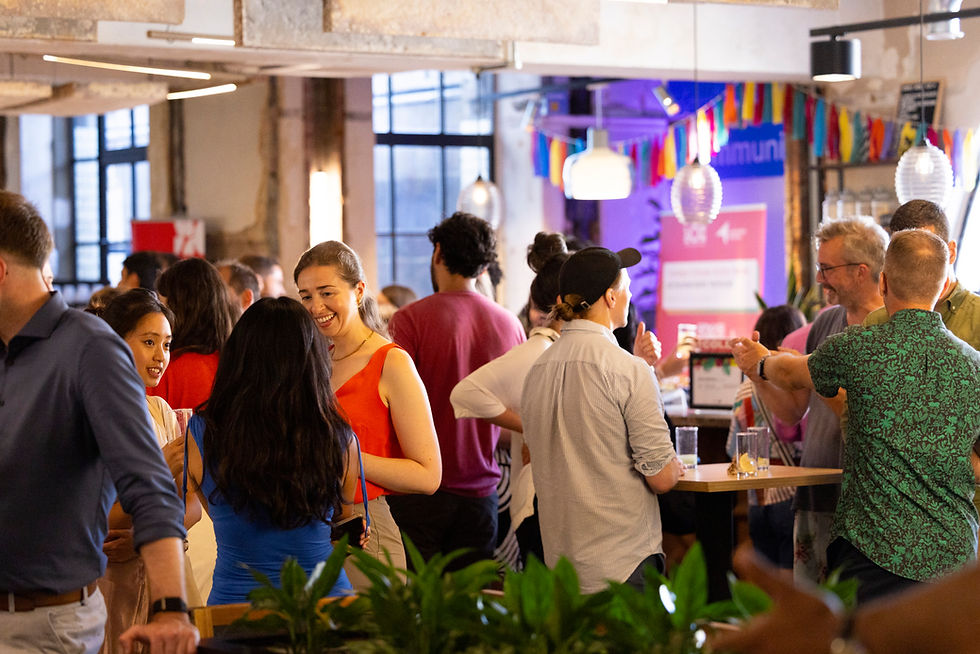
On 9 October, in partnership with the Ryan Institute at University of Galway, we took over Sult for the last word of The Atlantic Summit Galway 2026. Not a conference. Not a report launch. A room full of scientists, policymakers, founders, fishers and artists — cocktails in hand, big questions on the table.
It was also day one of something bigger: the official inauguration of the Galway Collective, the newest chapter of the Climate Cocktail Club, led by Javier Santoyo and opened alongside Liam M. Carr.

The brief for the night was simple. Claims being staked. Extraction mindsets growing. Justice threatened. Trust running out. Community rising. Same rooms, same people, same results?
Not tonight.
SCIENCE, WITH JOKES. THEN THE ROOM WENT QUIET.
Jessamyn Fairfield opened with the kind of keynote that shouldn't work and absolutely does. Science meets stand-up. Big ideas, sharp jokes, and improv that had the room laughing before it had the room thinking — and then thinking anyway.
Jessamyn lectures at University of Galway, has a TED Talk on the way, and has spent time on an Arctic residency asking a question most of us only ask privately: is my time worth being here doing this?
Her case: science and art are not separate languages. Communicating the existential environmental issues we all face is not a nice-to-have, a comms add-on or a slide at the end. It's the work. Her improv connected across world communities and did the thing data alone rarely manages.
It gave people hope.
THREE GENERATIONS, ONE SEA
Then the panel. Jan-Stefan Fritz (German Marine Research Alliance, Brussels, and Adjunct Lecturer, Ryan Institute, University of Galway), Karin Dubsky (Coastwatch) and Sarah Hegarty (BirdWatch Ireland) — a marine science diplomat, a coastal campaigner and a surfing marine biologist — hosted by David Scanlon of Resolve Partners.
Three generations on the same water, asked the question that actually matters when multilateral cooperation is wobbling: who looks after the ocean?
What came back was refreshingly unhedged:
Transformational change, not incremental tweaks. The scale of the problem does not match the scale of the response.
Laws that are effective and enforceable — and specifically the MPA legislation we have all, patiently, been waiting for.
Working together is not optional. Break down the silos. Foster diversity. Back young ocean professionals.
And a new way of seeing it: how we look after the ocean, and how we picture our ocean future, are the same conversation. Careers are not linear. If you were a master's student in that room, the message was aimed squarely at you. There is a place for you in this, and it doesn't have to look like a straight line.
"DON'T TRUST ANY COMPANY THAT SAYS IT'S CARBON NEUTRAL"
Margaret O'Gorman, CEO of Tandem Global, took the fireside chair and told us what sustainability actually looks like inside business — not the brochure version.
Companies care about risk. But there is still an intense disconnect between how business values nature and how we value nature. Greenwashing is still happening across the board. Margaret's provocation landed hard: you should not trust any company that says it is carbon neutral.
Carbon projects that fit in a credible climate strategy are genuinely difficult. With regulatory power behind it, it becomes possible. And one of the better shifts we heard about: companies now have to earn a social licence to operate — not assume one.
THE CALL TO ACTION
Katie Seaberg, PhD candidate and Hardiman Scholar at the Ryan Institute, closed the night with the headlines, the recipes and the receipts.
Her verdict as a PhD student at Galway: research can be fun — but more than that, research can connect scientific communities with the communities on the ground. And her takeaway was the one we're still carrying:
"What are you doing to make the world a better place?"
A call to action for all of us. Start where you actually are. Stop using single-use plastic. Then go further.
FAVOURITE MOMENTS
A few things we're still talking about. Both of them involving Karin, as it happens.
Karin Dubsky and the plastic spoon. She came prepared. Out came a single-use plastic spoon, held aloft on stage, mid-panel, as Exhibit A. Plastic cutlery has been banned in Ireland since 2021 — and yet it is still finding its way into people's hands. One small object, doing the job that no slide could.
Then she went for golf courses. Also in Karin's sights, and no offence to the Adare Manor sustainability manager who joined us that night — who took the hit with good humour, and who we were very glad to have in the room. The best conversations happen when the people being challenged are sitting close enough to answer back.
A room that argued. Scientists and fishers. Policy people and founders. Students who asked the second question, not just the polite one. Nobody came for the canapés.
SO — WAS IT WORTH IT?
Jessamyn asked that question in the Arctic. We asked it of the room in Galway. We got our answer on the drive home.
At a Circle K between Galway and home, one of our team was handed a plastic spoon. Reader, we said something. We pointed out — politely, and with the confidence of someone who had spent the evening listening to Coastwatch — that it was illegal. Plastic cutlery has been banned in Ireland since 2021. Not a grey area. Not a preference. The law.
That is the actual test of a night like that one. Not what the room nodded along to. What you do in a forecourt at eleven at night, when nobody is watching, the spoon is already in your hand, and the only person who'll hold you to it is you.
Karin would be proud. We think.
The following morning, back home, the same person ended up in a full-on debate about the food system in the local butchers. The butcher had views. Some locals joined in. It got lively. Nobody left with a tote bag either, but everybody left having thought about it.
So was it worth being here? Absolutely. Ask the Circle K. Ask the butcher. A good night doesn't end when the bar closes. It follows you into a forecourt, then into a queue for rashers, and it doesn't let go.
Jessamyn wondered, on an Arctic residency, whether her time was worth being here doing this. Hours later, a plastic spoon got refused in a petrol station. That's one small answer. We'll take it.
A room that starts with improv, moves through MPA legislation, holds up an illegal spoon, takes a swing at golf courses, stares down carbon neutrality claims and ends with a question about your own contribution is not a room that leaves quietly.
It leaves as a collective.
The Galway Collective is live. Come and find us at the next one. And bring your own cutlery.
GET IN THE CCC MOOD
Follow the Galway Collective for what's next — this chapter is just getting started.
Bringing a room of wavemakers together takes partners. Thank you to Ryan Institute, University of Galway (host), Be Impactful (knowledge), THINKHOUSE (brand), KPMG Ireland (supporting), and collaborators B Lab Ireland and Natural Capital Ireland.
Live music from The Westaways, Sailhymn and Sharpie — because a good idea goes down better with a soundtrack.
Want to host, sponsor or speak? Get in touch: info@climatecocktailclub.org


Comments