

Salmon, saunas and systems: Climate Carnival 2026 broke the silos (and a few comfort zones)

Carnival # 2 – From Silos to Systems, Ballintubbert House & Gardens, County Laois, 15-16 September 2026
Ballintubbert comes from the Irish Baile an Tobair: the place of the well. On 15–16 September, five hundred business, policy, science, farming, finance, activist and creative leaders came to drink from it. Not a conference. Definitely not a hotel function suite. A Climate Carnival, under canvas in the organic gardens of a County Laois country house, built around one idea: From Silos to Systems.
"This was my first (and hopefully not my last) Climate Carnival, and was definitely the most memorable gathering that I've attended in my 20+ years in the broader sustainability sector." Dermot Murray, Director of Sustainability and Climate Strategy, Constellation
The premise was simple and purposefully reckless. Take the people who never share a room – the dairy farmer and the ESG lead, the seahorse conservationist and the infrastructure engineer, the former President and the former Mary Walloper – and put them in the same one. Then curate it, create the climate for possibility and see what happens. Not left to chance: every stage, fireside, workshop and café was designed to stretch ideas and deepen engagement.
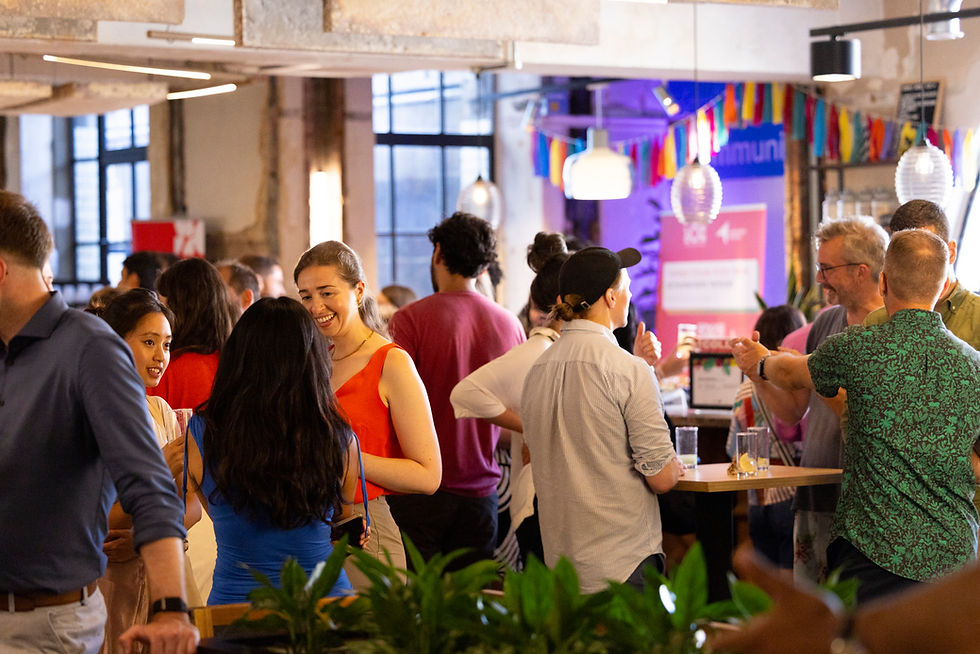
What happened was two days of salmon science, river plunges, plastics debates, screenwriters pitching the TV of a climate-altered future, a bilingual fireside as Gaeilge, a six-seat pop-up cinema, a climate café full of commitments, ghost stories, and a dance floor and sing-along that ran into the early hours. One attendee with twenty years in the sector called it the most memorable gathering he has ever been to. Somebody else, near the back, asked "what's a silo?" Both were right to be there.
This is the long read. Grab a mocktail.
DAY ONE: STRIP BACK, PLUNGE IN, EAT WELL
2025 was about bold, brave leadership. 2026 asked a harder question: what if the problem isn't a lack of solutions but the boxes we keep them in? Companies here, government there, community over there, nature somewhere out the back. At the level of the household, as one community facilitator put it, there are no separate sectors. You move through all of them before lunch.
So day one turned the lens inward before we pointed it anywhere else. Fifty people checked into an outdoor sauna on the banks of the River Stradbally with fisheries wizard Ken Whelan, landscape historian Clair McDonald, adventure swimmer Daragh Morgan and the Mountain Mermaid, Ireland's eco-mythologist and bean-seanchaí. Four guides, one river's story, no lanyards. Then the plunge. Literally. Nothing resets a room like cold water and the knowledge that the CEO beside you just screamed too.
That evening, the Climate Dinner Club. Two hundred changemakers under canvas, a zero-waste, three-course feast from FoodCloud where every course came with its own story, and IDA Ireland's Dr Matt Kennedy and FoodCloud's Aoibheann O'Brien setting the table. Then satire. Climate comedian Oli Frost took the mic as Shell's Head of Adaptation and Drinking to proudly present everything the company is doing about the climate crisis, including cocktail offsetting: one alcoholic, one mocktail, net zero. Daragh Morgan followed with a grounding on love and leadership that brought the tent back to earth. After dessert, Harrison Gardner sat down with Mary Robinson for a fireside on food, justice and leadership, and the tent held its breath at every word. Mary led on community action: showing up, energising local action on climate and nature, reconnecting with the issues and with each other, and going where the positive energy is. She asked the room to feel and connect first: to see and hear each other before anything else. Not a call to be bolder, a call to be human. A quiet counter to the top-down policy approach, from someone who has sat at the top of it. What struck us most was that everyone in the room had their own Mary story. The night she broke the mould to become Ireland's first woman President. The day she stood up for climate justice on a global stage. The day she came to my town, my school, my community. A catalyst, an inspiration and a champion we continue to admire and love. Then Seán McKenna picked up a guitar and the tent did the rest.
Daragh's line stuck: everything is possible if we increase the dosage of love. On paper, a bit much. In a tent full of people who spend their working lives being told no, it landed like a prescription.
“An event like no other. Hands down the best networking and informative event I have been involved in" Oscar Daly, Secretary, Costal Communities Network CLG
BE A GEOGRAPHER
Day two opened with an invitation rather than a keynote. Our founder Tom Popple and broadcaster Dr Tara Shine asked everyone to spend the day as a geographer. Why? Because geographers see the unseen: the connections between people, between people and nature, between politics and society. Miss those connections and you get stuck and make bad decisions. See them and you can move whole systems.
That was the operating instruction for five spaces, four stages, 50-plus speakers and 30-plus sessions. Ocean, Food, Habitats and Culture, each a system in its own right, each curated by a partner who lives in it and each designed to leak into the others. Pull on any thread and the rest moved. Tom also used the moment to launch the new BE IMPACTFUL brand, built on the same idea: put humans back in the decision-making seat and use the power of geography for accelerated impact across Climate, Land, Freshwater, Ocean and Community.
"This event showed the power of bringing different voices into one room and really listening. You discover how much is already happening, make new connections and leave with a stronger sense of what's possible." Ali Sheridan, Chair, Just Transition Commission
OCEAN: ONE SEA, TWO SHORES, SOME VERY AMBITIOUS SALMON
Fair Seas co-curated the Ocean Stage and set the tone with Ken Whelan, who delivered the quote of the Carnival. "Some of these salmon can climb mountains." He meant it: wild Atlantic salmon pushing up into first-order streams high in the hills and what their collapse tells us about every river, coast and sea they pass through. "Fat salmon and fat cows come from water on limestone. Up the hills you have hungry water." A whole systems lecture in two sentences, no slides required.
Then Oceans Apart put two young activists from two shores of the same crisis side by side. Flossie Donnelly from Ireland and Benjamin Bockarie from Sierra Leone, who has worked with coastal communities through GOAL Global and now studies coastal and marine management at UCC, talked mangroves, policy and the cost of inaction. "I am willing to take these actions," Benjamin said, "because I want to keep these communities and these people safe from the impacts of climate change." We share one ocean. We do not share one response.
And then a first for the Carnival: a fireside as Gaeilge. Eoin Warner, Lisa Murray, Afraic Ní Ríordáin and Aisling Ní Dhonnabháin explored what the Irish language knows about the sea that English misses. As Afraic put it afterwards, our place names, songs and stories hold insight about our landscapes and our relationship with them. Restoring land isn't just physical work. It's rebuilding a relationship and reconnecting with the language that helps us make sense of it. The day closed on Making Waves, where Linzi Hawkin and Daragh Morgan asked the question the movement avoids: who is looking after the people doing the looking after?
FOOD: MEDICINE, LAND AND THE CHOICE MYTH
Dr Rupa Marya, in a fireside with Mick Kelly, opened the Food Stage with a keynote that refused to separate the health of our bodies from the health of our land. Injustice gets written into both. Collective action is the cure. From there the Land Dialogue put farmers, a former minister, rewilders, policy and health voices in one circle, with Rob Yorke refereeing. Hard conversation, held well and the room found more common ground than the headlines ever do.
The Big Debate on plastics in the food system was played for sport and delivered. Plastic as the food system's great villain and its quiet saviour, with real trade-offs on waste, emissions, cost and infection risk, and a crowd that heckled with purpose. The Consumer Choice Myth then unpicked the supermarket as a temple of free choice, with FoodCloud's Aoibheann O'Brien among those showing where the real levers sit. Matt Winning closed the stage with Solastalgia, his five-star theatre-comedy on fatherhood, finance and fossil fuels, as the bar opened. Correct sequencing.
HABITATS: WHERE EVERYTHING LANDS
Commonland and Bioregioning Ireland, our Official Habitats Partner, co-curated the Habitats Stage around a single idea: we may split the economy, climate, food, health and culture into separate ministries and NGOs, but they all collapse into one in the lived experience of a place. Pieter Ploeg's morning fireside with Matt Winning traced the human work of systems change: persistence, imagination, trust and will. Then Weaving Systems brought Sarah Prosser, Zlatina Tsvetkova and Pauline McKeon together on the craft of convening people who never sit at the same table and why giving trust, building shared language and training our listening matter more than any framework.
Energising Habitats put Prof. Eoin O'Neill, Dermot Murray, Anthony Glynn and Mia Fahey McCarthy on grids, pipes and district heat, the unglamorous pipework of the transition and was briefly interrupted by a close encounter with Ireland's native money spiders. From the Land brought Irish voices on breaking the silos between landowners, communities and agencies. The day ended with Choctaw filmmaker Colleen Thurston and ecologist Anja Murray on Drowned Land, a story about a dam, a river and what it drowns beyond the water.
Zlatina summed up the stage better than we can: we have the technical solutions, the resources and the tools. Implementing them requires engaging with people, ourselves and each other, in a different way. Systems change doesn't happen without human change.
THE SYSTEMS CAFE: FROM INSIGHT TO ACTION
The day's ideas mean nothing if they stay in your notebook, so the Habitats Stage closed the loop. Three Keynote Listeners, Ali Sheridan, Dr Clare Noone and Molly Garvey, had spent the day listening for patterns across every stage. Zlatina Tsvetkova then hosted a Systems Café that turned those patterns into commitments.
A few that emerged:
"Use gaming tactics like Dungeons & Dragons to break roles and hierarchies in my organisation."
"Bring in more different voices in my leadership team."
"Connect Gaelgóirí with the Climate March."
"Leverage at least three contacts from today in my work."
"Create opportunities to bring people out of their silos to experience the overall direction of the organisation."
Molly's notebook caught the rest of the day's wisdom. A Laois dairy farmer: anyone, whatever their background, can find 60 per cent to agree on, but we focus on the 40 per cent we don't. A young sustainability professional: "I'm guilty of putting people in silos, making assumptions before they open their mouth. If I stopped this, I'd probably collaborate more." And from many, many people: "We have to be able to imagine it. Fear is not enough to make me act."
Ali's takeaway stayed with us too. Our challenges are more shared than our structures suggest. There is more happening than we realise and bringing it into one room shows the scale of what's already moving. How we do the work matters as much as the work. Resilience, yes, but also joy, relationships and hope. This is life's work.
CULTURE: THE INVISIBLE OPERATING SYSTEM
BE IMPACTFUL curated the Culture Stage on a simple premise. Culture eats strategy and the sharpest climate plan on paper dies without the culture to carry it. Mike Miles, Dermot Murray and Lene Mi Ran Kristiansen, steered by Dr Tara Shine, got under the bonnet of why transformation stalls: incentives, identity, habits, the everyday decisions nobody writes down. Carmel McQuaid followed with a rare, honest deep-dive on sixteen years holding the line on impact inside global brands, which fights are worth it and which to walk away from.
The schools showcase was quietly the most hopeful hour of the day. Dr Patrick Kirwan, Dr Mary Moore and Firhouse principal Claire Matthews on building a culture of impact before anyone reaches a boardroom, followed by the Portlaoise Schools Cluster Project: a two-year, student-led push across ten local schools that cut car use on the school run by 15 per cent. Cheapest systems win going.
Then the storytellers took over. Elaine Walsh and Daragh Goan of Green from Script to Screen brought six screenwriters to the Pavilion to pitch their climate-themed film and TV stories, two minutes each and the room pitched back. No magic tech, no hero inventors. Love stories, thrillers, comedies and horrors where a bog, a coastline or a damp flat carries its own arc and where a Laois farmer or a Dublin commuter can correct the script before it ever reaches a streamer. If culture decides which futures feel possible, this is where that gets written. Your seat was a seat in the writers' room.
After that, the argument got louder. Seán McKenna, Dr Rupa Marya and Hector Ó hEochagáin made the case that art doesn't inform a movement, it moves it. And Kealan Doyle, Breda Larkin and Hector chewed the fat on nature with the doom left at the door, before Breda's Joe Dolan tribute did things to the Mullingar contingent that we are not qualified to describe.
EXPLORE: NETS, WILLOW, PENCILS AND IDEAS
Away from the stages, the Main House and gardens ran a programme for people who learn with their hands. Kealan Doyle and Rob Gandola led a pond-dipping biodiversity field trip that reduced at least one seasoned broadcaster to childlike joy with a kick net. Three local primary schools joined in too. For many of the children it was their first time pond dipping, their first time this close to nature and the first time anyone had helped them understand it. Memories were made in those ponds, and they are the ones that last. Oscar Daly of Coast-Net taught by showing rather than telling: willow baskets, hand-made ropes and other natural craft laid out in the gardens, a beautiful setting for a reminder that the oldest sustainable skills we have are still among the best. Anne Harrington Rees took a group green sketching through the gardens. Mike Miles, Lucía Probst and Neal Anderson ran a founders' masterclass on mistakes, near-misses and the calls that took nerve. And Nishant Parekh declared sustainability reporting dead and asked what should replace it, and did so through a tech crisis and a wonky projector, which for a session on broken reporting felt about right. Nobody wore black.
Irish Trees brought a six-seat cinema and three minutes of life at Dunsany. Around 120 people stopped to talk and about 70 squeezed in to watch throughout the day. That is what a Carnival stall should be: a small door into someone else's system.
THE CRAIC WAS NOT OPTIONAL
If culture is the forgotten secret sauce of the movement, we poured it generously. Lírnan played the dinner in. Seán McKenna played it out. Lisa Murray's bilingual pop and the Three Rod Wale kids held the Tabernacle at lunchtime and, by all accounts, a session of Irish and American folk tunes (and Elvis) until the wee hours on both nights. Jack McHugh. Matt Winning. Breda Larkin. And Jerry Fish closing the whole thing with live music, a bar and a dance floor in a tent in a garden in Laois on a Wednesday night.
None of this is decoration. As Zlatina wrote afterwards, culture is what pulls people into a movement and invites them to engage as full human beings, driven by passion, curiosity, creativity and awe, rather than the fear that turns us into shadows focused on survival. Laughter, music, rest and time outdoors are not the break from the work. They are how the work gets done.
THE REVIEWS ARE IN
My (Tom) Mum and Aunty Kay had the first say and they were broadly positive (Hector, watch yourself). The rest of the crowd followed.
"This was my first (and hopefully not my last) Climate Carnival, and was definitely the most memorable gathering that I've attended in my 20+ years in the broader sustainability sector." Dermot Murray, Director of Sustainability and Climate Strategy, Constellation
"This event showed the power of bringing different voices into one room and really listening. You discover how much is already happening, make new connections and leave with a stronger sense of what's possible." Ali Sheridan, Chair, Just Transition Commission
"Climate Carnival managed to persuade enough diverse people to give up a whole day to get out of their silos and into a garden together. How many more can be convinced?" Molly Garvey, Keynote Listener
"It's a real cocktail of people from different walks of life and interests, joining together for conversations and workshops that are stimulating, informative, inspiring, emotional, sometimes disagreeable and sometimes fun, but always with a sense of purpose." Anne Harrington Rees, artist
"An event like no other. Hands down the best networking and informative event I have been involved in." Oscar Daly, Secretary, Coast-Net CLG
"Tom Popple is a master mixologist of minds. It takes a special kind of climate event to leave you feeling excited and hopeful." Emma Kate Butler, Design Manager, THINKHOUSE
"Systems change is undoubtedly complex and difficult. But if we each engage with the system, in our own way, leaning in to the parts that we can influence and collaborating across silos, the groundswell will grow, the ripples will spread, and change will happen." Karen Deignan, Co-Founder, SustainabilityWorks
"It was a great reminder that the challenges we're facing aren't isolated, and neither are the solutions." Aoife Hamilton, Irish Trees
"We left the day with new friends, fresh ideas, and a renewed sense of hope. The future is in safe hands if the conversations we had with the knowledgeable and well-informed school kids in attendance is anything to go by." Atlantic West Natura Communities
And a note for anyone whose boss wouldn't sign off a day at something with "Cocktail" in the name: we've heard you. Mocktail Club is under consideration. Sort of.
WHAT WE LEARNED
Three things and we'll keep them short because the come-down is real.
First, the container matters. Ken Whelan said he learned a lot and made loads of new contacts. So did almost everyone and it is no accident. Land, nature, shelter, calm, music and a bit of cold water build the trust that a hotel ballroom never can. The conversations people had here are the ones they have never had before, with people they would never otherwise meet.
Second, silos don't dissolve on a slide. They dissolve when a dairy farmer and a rewilder discover the 60 per cent, when a Choctaw filmmaker and an Irish ecologist find they are telling the same story about a river, when a seahorse campaigner, a farming comedian and a broadcaster chew the fat and nobody wins. Systems thinking is not a framework. It is a room.
Third, joy is infrastructure. The people fighting for the ocean, the land and the climate are burning out. A movement that doesn't care for its own won't last. Laughter, art, music and being outdoors are how we stay in the work long enough to finish it.
THANK YOU
None of this happens without the people who mucked in. Our deepest thanks to Ballintubbert Gardens and House for the place of the well; to Laois County Council and Climate Action Laois, our official host partner; to BE IMPACTFUL and Salty Dog, official knowledge partners and Culture Stage curators; to Commonland and Bioregioning Ireland, official habitat partners; to Fair Seas for curating the Ocean Stage; to IDA Ireland, official dinner partner, and FoodCloud for feeding us with zero waste and every course a story; to THINKHOUSE, official brand partner, for a logo that came alive; to H&MV Engineering, our cocktail partner; to KINTOJOIN, sustainable transport partner; to SETU and UCC, public sector pavilion partners; to supporting partners KPMG, Wilderway, Bord Bia and Business for Biodiversity Ireland; and to our collaborators Project Dandelion, SustainabilityExamples.com, B Lab, Natural Capital Ireland, Our Story, Eco Friendly Cups, Irish Trees, FoodCloud and more.
To every speaker, performer, moderator, exhibitor, volunteer and crew member: thank you. To Louise French, Muriel Murphy, Bronwyn Walsh, Mary Hachey, Javier Santoyo and the whole Climate Cocktail Club and LPM Bohemia team who made a slightly bonkers idea run like a system: thank you. And to Mum and Aunty Kay: we'll take the review.
SEE YOU IN 2027
2025 was about leadership. 2026 was about systems. 2027 is about the how. We'll say more soon, but the shovels are already being sharpened.
In the meantime, one question, borrowed from Pieter Ploeg: what's one step you will take to break a silo? Tell us. Better still, do it, then tell us.
And if you were there, tell us how it was. Two minutes on our feedback form shapes what 2027 becomes. The good, the bad and the wonky projectors, we want it all.
Find us at climatecocktailclub.org and follow #ClimateCarnival2026 for the photos, videos and the serious Climate Carnival overload we warned you about.


Comments